
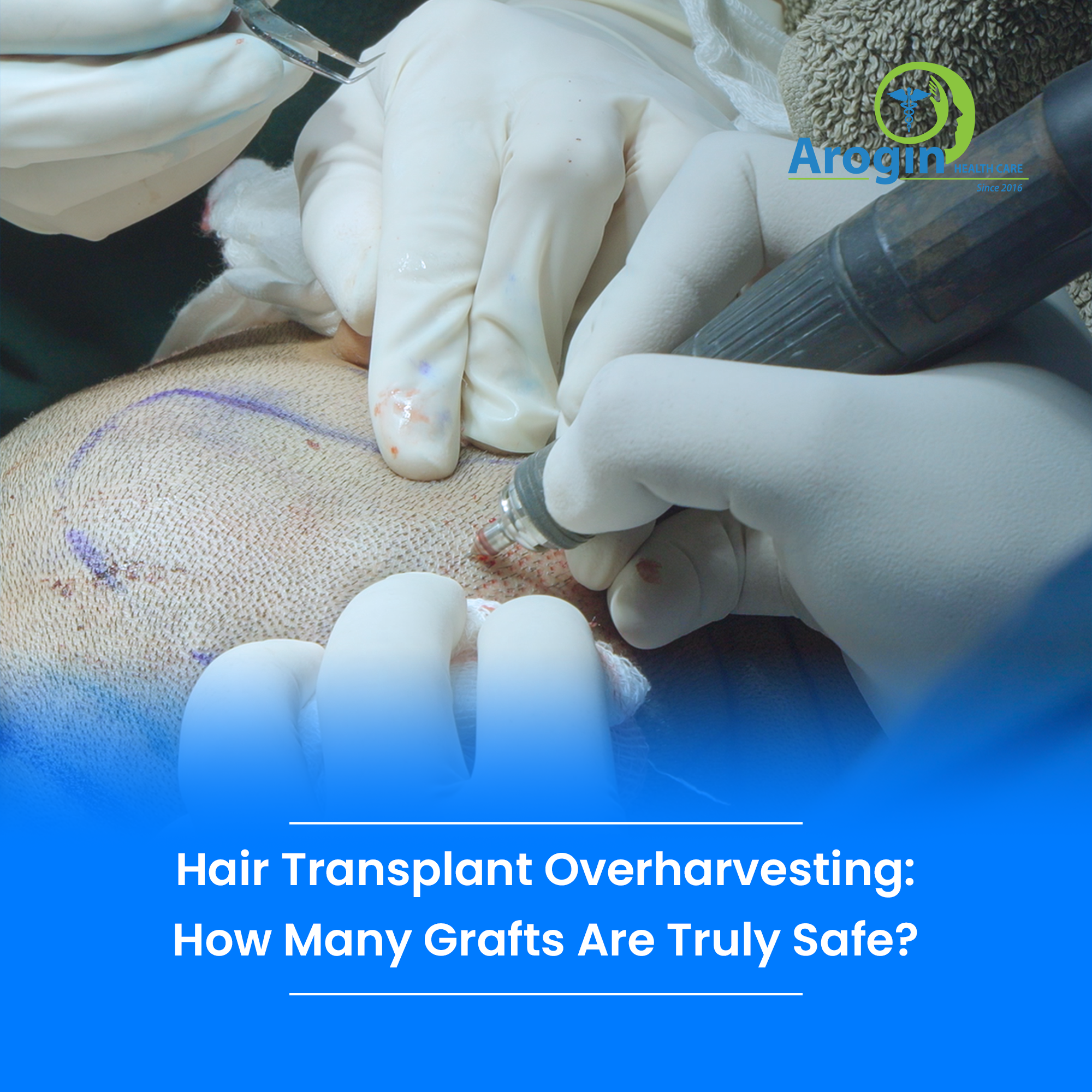
Overharvesting happens when more hair follicles are taken from donor area than scalp can safely handle. donor area, usually back and sides of head, has a fixed supply of follicles. Once these follicles are removed, body cannot replace them.
At Arogin Healthcare in Bishalnagar, Kathmandu, donor safety is treated as a long-term responsibility. goal is not to extract highest possible graft number in a single sitting, but to protect donor area for both present results and future needs. When patients understand how overharvesting occurs and how safe graft limits are decided, they are far less likely to face damage that cannot be reversed later.
What Is Overharvesting in a Hair Transplant?
Overharvesting occurs when follicular units are removed beyond donor area’s ability to maintain a natural appearance. This risk exists even with modern procedures such as FUE or DHI.
Every donor area has a natural spacing and pattern of hair follicles. When grafts are taken too close together or repeatedly from same zones, scalp can no longer hide missing hair. Over time, this leads to visible thinning, uneven patches or scarring, especially under strong lighting or when hair is worn short.
Unlike temporary shedding after surgery, overharvesting is permanent. Once a follicle is removed, it does not grow back. This is why careful donor evaluation and conservative extraction planning are medically necessary, not optional.
Why Overharvesting Causes Permanent Damage
A healthy donor area depends on balance. Hair density, spacing between follicular units, scalp features and pattern of extraction all affect how area looks after healing.
When too many grafts are removed, remaining hair becomes unevenly spread. More scalp becomes visible, light reflects more easily and extraction marks may overlap. Over time, this makes thinning and scarring more noticeable. In severe cases, donor area may no longer be suitable for any future hair transplant.
This is also why donor damage often becomes clearer months after surgery, once surrounding hair grows and contrast increases.
How Many Grafts Are Too Many?
There is no single graft number that is safe for everyone.
A graft count that works well for one patient may cause damage in another, even if their hair loss looks similar. Safe extraction limits depend on donor-specific factors, not just size of bald area.
Important factors include natural donor density per square centimeter, hair thickness, follicle distribution, scalp flexibility, healing tendency, age and expected future hair loss.
As a general medical guideline, many patients should avoid going beyond 3,000 to 4,000 grafts in one session. Higher numbers increase chance of visible donor thinning unless patient has strong donor characteristics and grafts are spread evenly across safe zones.
Safe Graft Estimates by Norwood Scale
The Norwood Scale helps describe how advanced hair loss is, but it does not measure donor strength. This difference is often misunderstood.
Patients in Norwood Stage II to III commonly need around 1,000 to 2,000 grafts. Stage IV to V may need 2,000 to 3,500 grafts. Stage VI to VII can require 3,500 to 5,000 or more grafts, usually planned across more than one session.
Advanced hair loss does not automatically mean more grafts can be taken safely. In many cases, patients with higher Norwood stages have weaker donor reserves and need a more cautious approach.
As a general safety limit, removing more than 20 to 30 percent of follicular units from same donor zone can lead to visible thinning, regardless of technique used.
Donor Area Capacity Versus Desired Density
A successful hair transplant is not measured by how many grafts are placed in a single day. It is measured by how natural donor area continues to look years later.
The donor area is a limited resource. Once it is exhausted, it cannot be restored.
Responsible graft planning balances immediate improvement with future hair loss, possible need for further procedures and natural appearance in both donor and recipient areas. Very aggressive density targets may look impressive early on, but they often reduce long-term options.
Signs of an Overharvested Donor Area
Early signs of donor overharvesting may be subtle, while long-term damage is usually clear.
Common signs include thinning at back or sides of scalp, uneven density under bright light, clustered extraction marks and small dotted scars that become obvious with short hairstyles.
One of most serious outcomes is losing option for future hair transplant procedures due to lack of usable donor hair.
How to Avoid Overharvesting in a Hair Transplant
Avoiding overharvesting depends more on planning and professional judgment than on devices or marketing claims.
A responsible clinic performs a detailed donor evaluation that includes density measurement, checking for follicle miniaturization, mapping safe donor zones and planning graft use over long term.
For many patients, dividing treatment into planned stages is safer than attempting a very large single-session procedure.
Hair Transplant Approach at Arogin Healthcare, Kathmandu
Arogin Healthcare in Bishalnagar, Kathmandu follows donor-first planning with a focus on long-term outcomes rather than short-term density promises.
Every patient receives a detailed scalp and donor assessment before any graft numbers are decided. Treatment plans are based on current hair loss, expected progression and donor limitations.
Modern FUE and DHI procedures are performed using controlled extraction patterns to maintain even donor density. For advanced hair loss, staged sessions are advised instead of high-risk mega sessions. Unrealistic graft claims are avoided to protect donor health and future options.
FAQs About Hair Transplant Overharvesting
Can an overharvested donor area recover?
No. Once follicles are removed, they do not regenerate. Medications may improve look of remaining hair, but they cannot replace lost follicles.
Does a 5,000+ graft session always mean overharvesting?
Not always, but risk is higher. Such sessions are suitable only for carefully selected patients and are often safer when split into multiple procedures.
Can overharvesting be repaired later?
Repair options are limited. Some cases may benefit from careful camouflage or redistribution, but original donor density cannot be restored.
How can patients identify a safe clinic?
Safe clinics explain graft planning clearly, recommend conservative limits, show real patient results and focus on protecting donor area rather than promising maximum graft numbers.
Book a Hair Transplant Consultation in Kathmandu
If you are concerned about donor safety or want a medically sound graft plan, Arogin Healthcare in Bishalnagar, Kathmandu offers professional hair transplant consultations focused on long-term results.
A proper consultation helps you understand your true donor capacity and avoid permanent mistakes before they happen.