
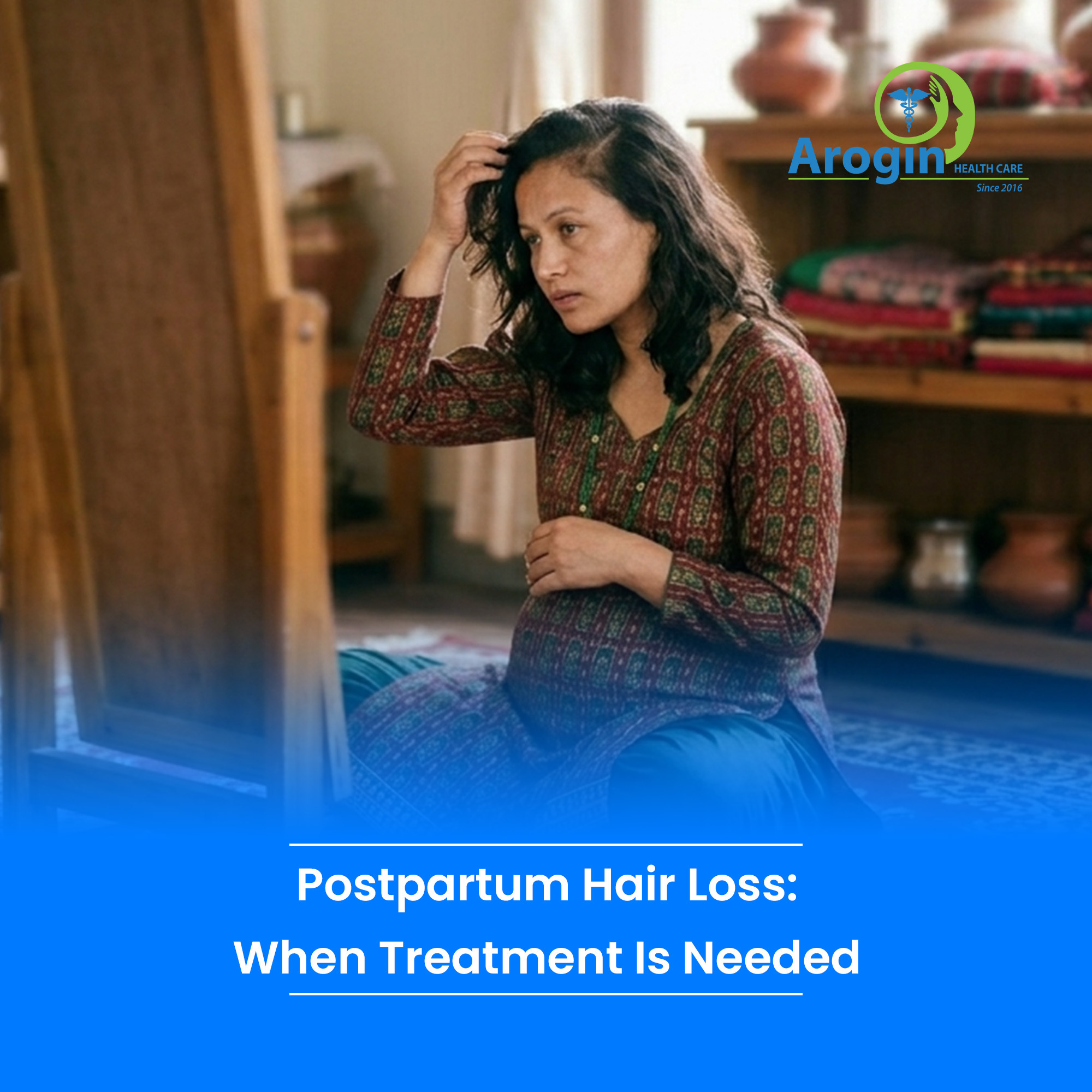
At Arogin Health Care, we have evaluated postpartum hair loss patterns for more than a decade. One of most common concerns we hear is, “I was told it’s normal but my hair is still falling.”
Knowing what is normal, what is not and when treatment is needed makes all difference.
What Is Postpartum Hair Loss?
Postpartum hair loss is a form of telogen effluvium, a condition where hair enters shedding phase earlier than usual.
During pregnancy, high estrogen levels keep hair in growth phase longer. Hair feels thicker and fuller. After childbirth, hormone levels drop suddenly. As a result, many hair follicles shift into resting phase at same time, leading to noticeable shedding.
This type of hair loss is common and affects women worldwide.
When Does Postpartum Hair Loss Start?
In most women, postpartum hair loss begins 2 to 4 months after delivery.
This timing often causes confusion. Many mothers do not connect hair fall to pregnancy because it starts weeks after childbirth, not immediately.
Shedding may feel sudden but process actually began earlier at follicle level.
How Long Does Postpartum Hair Loss Last?
For most women, postpartum hair loss lasts 3 to 6 months.
Hair growth usually starts to normalize by time baby is around one year old. New baby hairs may appear along hairline and parting area, which is a positive sign of recovery.
However, not everyone follows same timeline.
What Is Considered Normal Postpartum Hair Loss?
Postpartum hair loss is usually considered normal when:
- Shedding is diffuse, not patchy
- The scalp remains healthy
- Hair density gradually improves
- New regrowth appears within months
In these cases, reassurance, nutrition support and scalp care are often enough.
When Postpartum Hair Loss Needs Treatment
Based on years of clinical observation, postpartum hair loss may need medical evaluation when it does not follow expected recovery pattern.
You should seek treatment if:
- Hair shedding continues beyond 6 to 9 months
- Hair density keeps worsening instead of stabilizing
- The scalp becomes clearly visible
- There is no sign of regrowth
- Hair loss was present even before pregnancy
In many such cases, postpartum shedding is unmasking an underlying condition, rather than being only cause.
Common Conditions That Prolong Postpartum Hair Loss
In real-world practice, prolonged postpartum hair loss is often linked to one or more of following:
- Iron deficiency or anemia
- Thyroid imbalance
- Vitamin deficiencies
- Polycystic ovary syndrome (PCOS)
- Genetic hair loss triggered earlier by pregnancy
Pregnancy acts as a stressor that reveals hair loss patterns that were already developing silently.
Can Postpartum Hair Loss Become Permanent?
Postpartum hair loss itself is not permanent.
However, if genetic hair loss or medical conditions are involved hair loss may continue unless treated. This is why early evaluation is important, especially for women with a family history of thinning hair.
Waiting too long can reduce effectiveness of non-surgical treatment options.
When to See a Hair Specialist
You should consult a hair specialist if:
- Hair fall is heavy and ongoing
- Hair feels thinner than before pregnancy
- There is a family history of hair loss
- You want to protect long-term hair density
At Arogin Health Care, evaluation focuses on identifying whether hair loss is purely postpartum-related or part of a larger pattern that needs treatment.
Treatment Options for Postpartum Hair Loss
Treatment depends entirely on cause and stage of hair loss. In early or uncomplicated cases, treatment may include:
- Nutritional correction
- Medical scalp therapy
- Hair growth support plans
- Monitoring without aggressive intervention
The goal is always to restore balance and protect existing hair, not rush into unnecessary procedures.
Conclusion
Postpartum hair loss is common but it should not be ignored when it persists or worsens. Understanding difference between normal recovery and treatable hair loss is key.
At Arogin Health Care, postpartum hair loss is approached with medical clarity, patience and long-term planning. Hair is not treated as a cosmetic issue but as part of overall health.
When treatment is needed, acting early protects not just hair but confidence as well.