
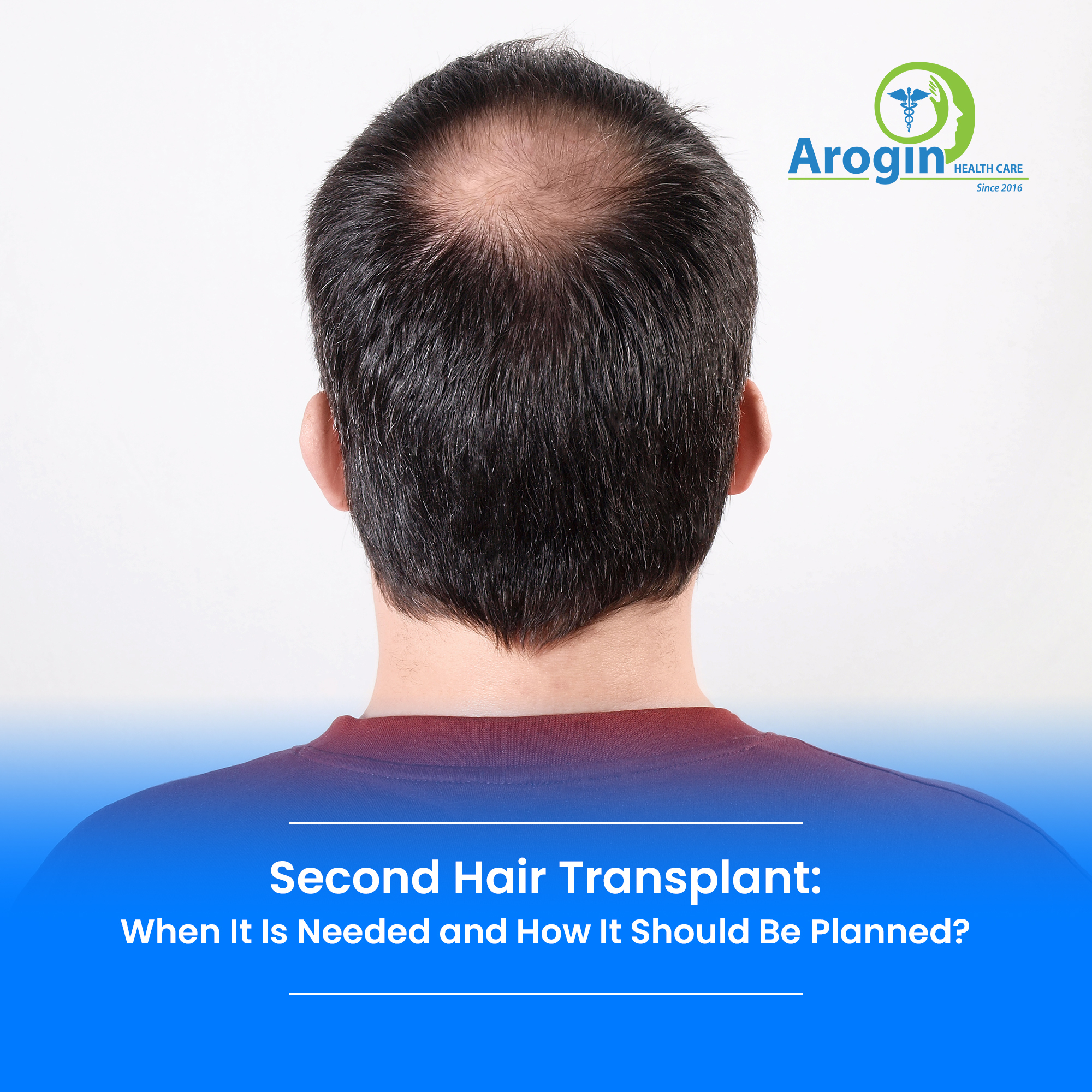
At Arogin Health Care in Bishalnagar, Kathmandu, every hair transplant is planned with the future in mind. A second procedure is never treated as an afterthought. It is approached as a medical decision that depends on donor biology, scalp condition, previous graft usage and how hair loss has evolved since the first surgery.
This guide explains when a second hair transplant is medically justified, how it should be timed and what separates safe secondary transplants from permanent donor damage.
When Is a Second Hair Transplant Medically Necessary?
Progressive Genetic Hair Loss After the First Transplant
Androgenetic alopecia does not stop after a transplant. A procedure replaces hair that is already lost but it does not protect surrounding natural hair from future loss.
Patients who undergo a transplant at an early stage often return years later with thinning behind the transplanted zone or in the crown. The original hairline may still look natural but density becomes uneven as untreated areas continue to thin.
In these cases, a second hair transplant is not a failure of the first surgery. It is part of managing a lifelong condition with controlled and staged intervention.
At Arogin Health Care long-term loss patterns are assessed before recommending further surgery so grafts are placed where they will remain useful for decades.
Density Limits in Large Bald Areas
There are medical limits to how many grafts can be placed safely in one session. Overloading the scalp reduces blood supply and lowers graft survival. Ethical surgeons intentionally limit graft numbers to protect both the recipient area and the donor zone.
For patients with extensive baldness especially Norwood grade V and above a single session may restore shape but not fullness. A second procedure allows additional grafts to be placed once the scalp has healed and circulation has stabilized.
This staged method produces thicker more natural results without sacrificing donor safety.
Repairing a Poor or Unsafe Previous Transplant
Secondary hair transplants are often requested by patients who had surgery elsewhere and were left with:
- Sparse growth
- Plug-like or poorly angled hairlines
- Visible donor thinning from overharvesting
- Patchy density due to poor graft handling
Corrective work requires more precision than a first transplant. Existing grafts must be protected, scar tissue must be respected and donor reserves must be managed conservatively.
At Arogin Health Care, corrective cases are evaluated slowly and honestly. If donor damage is already present, surgery is planned around what remains rather than attempting unrealistic coverage.
Hair Loss from Scars, Burns or Trauma
Scalp scars have reduced blood supply and different healing behavior. Attempting full coverage in one session often leads to poor growth.
In these cases, hair is transplanted gradually over multiple sessions. This allows the scalp to adapt and improves graft survival while reducing risk.
How Long Should You Wait Before a Second Hair Transplant?
A second hair transplant should never be rushed.
A minimum gap of 12 months is required between procedures. This period allows:
- Full growth and maturation of transplanted hair
- Complete healing of the donor and recipient areas
- Clear assessment of ongoing hair loss
- Accurate planning for future coverage
At Arogin Health Care, second procedures are scheduled only after the first result can be judged clinically not cosmetically.
How Many Hair Transplants Can a Person Have?
There is no fixed number. What matters is donor biology and how intelligently it is used.
The safe number of procedures depends on:
- Original donor density
- Previous graft extraction pattern
- Scalp laxity and healing response
- Surgical technique used
Most patients reach their aesthetic goals within one or two procedures. Some may undergo additional sessions if donor planning has been conservative and technically sound from the start.
Why Donor Area Management Determines Everything
The donor zone usually the back and sides of the scalp contains a finite and non-renewable supply of follicles. Once removed they do not return.
Poor donor planning leads to:
- Visible thinning at the back of the scalp
- Limited options for future surgery
- Artificial looking density transitions
At Arogin Health Care, donor safety is treated as a medical priority not a cosmetic compromise. Extraction patterns are designed to preserve uniform density even after multiple procedures.
Your second transplant is only as successful as what was protected during the first.
Techniques Used for Second Hair Transplants at Arogin Health Care
Secondary procedures demand higher accuracy than primary surgeries. Grafts must be placed between existing hairs without disturbing earlier growth.
At Arogin Health Care, second hair transplants involve:
- B.E.S.T. (Bio Enhanced Simultaneous Transplant) using ATP solution to support graft vitality
The B.E.S.T. technique is particularly valuable in secondary procedures where scalp conditions are less forgiving and graft survival must be maximized.
Setting Realistic Expectations
A second hair transplant can noticeably improve density and balance but outcomes depend on biology and planning, not promises.
Results vary based on:
- Remaining donor availability
- Extent of ongoing hair loss
- Scalp condition after the first surgery
- Post-operative compliance
Patients are counseled honestly about what can and cannot be achieved. Surgical restraint is often what preserves long-term satisfaction.
Why Patients Choose Arogin Health Care in Kathmandu
Patients seeking a second hair transplant often arrive cautious and informed. Many have already experienced disappointment elsewhere.
Arogin Health Care is chosen because of:
- Individualized surgical planning
- Medical decision-making led by experience
- Ethical donor preservation
- Use of advanced implantation techniques
- Clear pre- and post-operative guidance
Every procedure is planned with the assumption that the patient may need options in the future.
Final Thoughts
A second hair transplant is not a cosmetic redo. It is a medical continuation of hair loss management.
When timed correctly and planned responsibly it can restore balance, density and confidence without compromising donor health.
If you are considering a second hair transplant in Nepal, a proper evaluation is essential. At Arogin Health Care, Kathmandu, consultations focus on facts, not sales, so patients understand exactly what is possible and why.